LOTUS EVORA S

The Lotus Evora is a sports car produced by British car manufacturer Lotus. READ MORE....

TOYOTA RACTIS

The Toyota Ractis is a subcompact car produced by the Japanese automakers Toyota and Kanto Auto Works. READ MORE...

LAMBORGHINI SESTO ELEMENTO 2011

The Lamborghini Sesto Elemento (literally "Sixth Element" in Italian) is a two-seater. READ MORE ...

PORSCHE CAYMAN 2011

The Porsche Cayman is a mid-engined, rear wheel drive 2-seat sports car produced by Porsche AG of Germany. READ MORE...

LOTUS ESPRIT 2013

The Lotus Esprit is a sports car that was built by Lotus in the United Kingdom. READ MORE...

Tampilkan postingan dengan label Lamborghini. Tampilkan semua postingan

Selasa, 05 Juli 2011

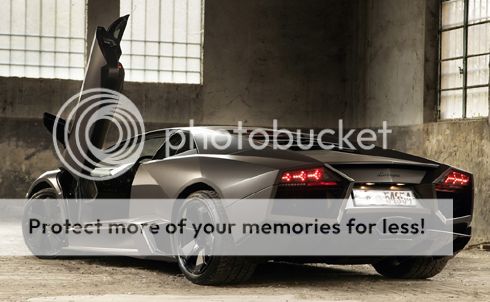
Lamborghini Reventón


The Lamborghini Reventón (Spanish pronunciation: [reβenˈton]) is a mid-engine sports carthat debuted at the 2007 Frankfurt Motor Show. It is the most expensive Lamborghini road car to date, costing one million euros (~US$1.5 million, or ~£840,000).[1] Its top recorded speed was recorded in Dubai, UAE at 356 kilometres per hour(221.2 mph). The official press release stated that only 20 vehicles would be sold to the public,[2] with one additional car (marked as 0/20) produced for the Lamborghini Museum.[3] Although early rumors indicated the total number would actually be 100,[2][4][5] each Reventón is clearly stamped with its number in the sequence of 20 between the driver's and passenger's seats.


Despite the exterior being new,[2] almost all the mechanical elements (including the engine) are sourced directly from the Murciélago LP640.[6]According to the official press release, the Reventón exterior styling was inspired by "the fastest airplanes".[7] To emphasize this, Lamborghini staged a race between a Reventón and a Panavia Tornado fighter plane on a 3 km long runway. The Reventón was in the lead for most of the race, but the Tornado caught up "in the last few feet" of the race.[8]

The Reventón is named for a fighting bull, in line with Lamborghini tradition. The bull, raised by the Don Heriberto Rodríguez family, was best known for killing famed Mexican bullfighter Félix GuzmÔn in 1943.[9][10] Reventón means "explosion" or "burst" in Spanish, when used as a noun.[11][12] In the vernacular, it is also used to define a very large party or a night in town. In automotive terms, it means "blowout, flat tire" when used as a noun.[13] When it was used as the name of a bull, however, it was intended to be interpreted as an adjective, a quality or property of that bull in particular. In this last sense, Reventón means "he who seems to be about to burst".

Lamborghini MurciƩlago

The Lamborghini MurciƩlago is a twodoor, two-seat sports car produced by Italian automaker Lamborghini between 2002 and 2010. Successor to the Diablo and flagship of the automaker's lineup, the MurciƩlago was introduced as a coupƩ in 2001 as a 2002 model. The automaker's first new design in eleven years, the car was also the brand's first new model under the ownership of German parent company Audi. It was styled by Peruvian-born Belgian Luc Donckerwolke, Lamborghini's head of design from 1998 to 2005.


A roadster version was introduced in 2004, followed by the updated LP 640 coupƩ and roadster and limited edition LP 650-4 Roadster. The final variation to wear the MurciƩlago nameplate was the LP 670-4 SuperVeloce,

powered by the largest and final evolution of the historic Lamborghini V12 engine. Production of the MurciƩlago ended on November 5, 2010, with a total run of 4,099 cars.[3] Its successor, the Aventador, was released at the2011 Geneva Motor Show.

In a continuation of Lamborghini's tradition of naming its cars after stars from the world of bullfighting, the Murciélago was named for a fighting bull that survived 28 sword strokes in an 1879 fight against Rafael "El Lagartijo" Molina Sanchez, at the Coso de los califas bullring in Córdoba, Spain. Murciélago fought with such passion and spirit that the matador chose to spare its life, a rare honor. The bull, which came from Joaquin del Val di Navarra's farm, was later presented as a gift to Don Antonio Miura, a noted local breeder; thus began the famed Miura line of fighting bulls, and the name for one of Lamborghini's greatest designs.

Murciélago is the Spanish name for the bat. The word is pronounced [murθiˈelaɣo], with a voiceless dental fricative [θ] (as in English thing), in the Castilian Spanish spoken in most of Spain. However, the Italian automaker often uses the Southern Spain and Latin American Spanish pronunciation, [murˈsjelaɣo], with an [s] sound.

Lamborghini Gallardo


The Lamborghini Gallardo (pronounced /É”aɪˈjɑrdoʊ/, Italian: [É”aŹŽĖˆŹŽardo]) is a sports car built byLamborghini. The Gallardo is Lamborghini's most-produced model to date, with over 10,000 built in its first seven years of production.[3] The car is named after a famous breed of fighting bull. TheSpanish word gallardo translates into "gallant".


The Gallardo offers two choices of transmissions, a conventional (H-Box) six-speed manual transmission, and an advanced six-speed electro-hydraulically controlled semi-automatic robotized manual, which Lamborghini abbreviates to "E-gear". The "E-gear" allows the driver to make shifts much faster than a manual transmission would. The driver shifts up and down via paddles behind the steering wheel, but can also use an automatic mode.[4]


For the MY2006 (launched in late 2005) Lamborghini introduced many changes to the car to counter some criticisms garnered by the press and owners. These were derived from the limited edition Gallardo SE. The exhaust system was changed to a more sporty one (including a flap to make it quieter around town), the suspension was revised and a new steering rack was fitted, the engine power was increased by 20 bhp to a maximum of 512 brake horsepower (382 kW), the biggest change was an overall lowering of the gearing especially in 1st to 5th. The result was a much improved car; it handled and turned better, sounded better under full throttle and the extra power and lower gearing turned an already fast car into a seriously quick one.

The Audi R8 sports car, launched in early 2007, is based on the Gallardo platform, and uses a 4.2 litre V8 in place of the Gallardo's V10 to avoid competing directly with the Gallardo. In December 2008, Audi unveiled a V10 Audi R8, with a detuned version of the Gallardo's engine, placed between the R8 V8 and the Gallardo.

For the 2008 model year, features added to the Gallardo included an onboard computer, iPodconnectivity with USB, heated mirrors, Q-citura stitching that originally could only be found on the Nera model, and a beige soft-top on the Spyder.

Senin, 04 Juli 2011

Lamborghini Countach

The Lamborghini Countach was a mid-enginedsports car produced by Italian automakerLamborghini from 1974 to 1990. Its design both pioneered and popularized the wedge-shaped, sharply angled look popular in many high performance sports cars. The "cabin-forward" design concept, which pushes the passenger compartment forward in order to accommodate a larger engine, was also popularized by the Countach.

In 2004, American car magazine Sports Car International named this car number three on the list of Top Sports Cars of the 1970s, and it was listed as number ten on their list of Top Sports Cars of the 1980s.

The Countach was styled byMarcello Gandiniof the Bertonedesign studio, the same designer and studio that designed theMiura. Gandini was then a young, inexperienced designer—not very experienced in the practical, ergonomic aspects of automobile design, but at the same time unhindered by them. He produced a quite striking design. The Countach shape was wide and low (42.1 inches), but not very long (only 163 inches). Its angular and wedge-shaped body was made almost entirely of flat, trapezoidal panels.

The doors, a Countach trademark, were scissor doors: hinged at the front with horizontal hinges, so that the doors lifted up and tilted forwards. The main reason is the car's tubular spaceframe chassis results in very high and wide door sills. It was also partly for style, and partly because the width of the car made conventional doors impossible to use in an even slightly confined space. Care needed to be taken, though, in opening the doors with a low roof overhead. The car's poor rear visibility and wide sills led to drivers adopting a method of reversing the car for parking by opening the door, sitting on the sill, and reversing while looking over the back of the car from outside.

The pure style of the prototype was progressively enhanced or cluttered (depending on one's point of view) by the evolution of the car to improve its performance, handling, tractability, and ability to meet mandated requirements. This began with the first production model, which included several vents which were found to be necessary to cool the engine adequately. These included the iconic NACA duct on the door and rear fender of each side of the car. The car design changes ended with a large engine vent directly behind the driver, reducing the rear view. Later additions, including fender flares, spoilers, carburetor covers, and bumpers, progressively changed the aesthetic values of the car.

The Countach's styling and visual impression caused it to become an icon of great design to almost everyone except automotive engineers. The superior performance characteristics of later Lamborghini models (such as the Diablo, or the MurciƩlago) appealed to performance car drivers and engineers, but they never had the originality or outrageousness that gave the Countach its distinction. The different impressions left by the various Lamborghini models have generated numerous debates and disagreements over what constitutes 'classic' or 'great' automotive design (elegant looks and style, vs.technical and engineering superiority).


Lamborghini Sesto Elemento 2011

The Lamborghini Sesto Elemento (literally "Sixth Element" in Italian) is a two-seater,

V10 high-performance concept car produced by Italian automaker Lamborghini, which debuted at the 2010 Paris Motor Show. The Sesto Elemento is equipped with a 6-speed paddle-shift, semi-automatictransmission and

all-wheel-drive system, mated to a 5.2-litre V10 engine borrowed from theLamborghini Gallardo,


generating 570 horsepower and 540 Nm (398) ft-lb of torque. The chassis, body, driveshaft and suspension components are made of carbon fiber,


reducing the overall weight to a mere 999 kg (2,202 lbs), making it the lightest car Lamborghini has ever produced. Perspired air is released through 10 distinctive he

xagonal holes in the engine cover,

while two intakes funnel cool air into the mid-mounted engine compartment. The Sesto Eleme

nto's high amount of horsepower combined with low overall weight translate to a power-to-we

ight ratio of 0.57 hp/kg (0.26hp/lb). Lamborghini claims a 0–100 km/h (0-62 mph) acceleration time of just 2.5 seconds, and a top speedin excess of 300 km/h (186 mph). Lamborghini sources said "...It will never be road legal".

Autoweek Magazine said a "...A stratospheric price tag, perhaps about $2.8 million..." The car is featured in the video game Need for Speed: Hot Pursuit,

in the downloadable content (DLC) pack Lamborghini Untamed,


alongside the digitalized Lam

borghini Countach and Lamborghini Diablo SuperVeloce.

The Sesto Elemento's name stems from the car's extensive use of carbon fiber, carbon being the sixth element in the periodic table of elements.


Share

Twitter Delicious Facebook Digg Stumbleupon Favorites More